
This article is about the act of colonizing a new planet. Adding more planets can increase your resource production and the reach of your fleets.
To colonize a new planet, you must send a colony ship on the colonization mission type. The ship will only colonize the planet if you have a sufficient level of astrophysics technology to allow another planet above what you already have. Every other level (1,3,5,7) of astrophysics allows you an additional colony slot (refer to the table in astrophysics for more details).
Basics
The position you pick in a solar system will determine the planet you receive and what it will produce.
- Each position has a different possible range of planet fields which control how much you can build on a planet. When you colonize, the amount of fields will be randomly assigned within this range. (And then increased by the universe settings and your class, if applicable). If you receive a planet you deem too small for long-term use, it is possible to abandon the planet and recolonize. The biggest planets are generally found in position 8.
- The position affects the temperature of the planet. This in turn determines energy production from solar satellites and deuterium production. Colder planets produce less energy from solar satellites, but yield more deuterium. The best deuterium production is found in position 15, and the best solar satellite energy production in position 1. When you colonize a planet, the temperature is randomly assigned within the possible range of the position.
- Positions 1-3 receive a bonus in their production of crystal. The highest crystal production is found in position 1, which has a 40% bonus. Position 2 has a 30% bonus and Position 3 has a 20% bonus.[1]
- Positions 6-10 receive a bonus in their production of metal. The highest metal production is found in position 8, which has a 35% bonus. Positions 7 and 9 have a 23% bonus and positions 6 and 10 have a 17% bonus.[2]
Planet field and temperature ranges for each position
The average planet sizes and temperatures for each position[3]
| Position | Minimum Size [4] | Average Size | Max Size | Minimum (Max) Temp
[5] | Average (Max) Temp | Maximum (Max) Temp | Comments |
|---|
| 1 | 96 | 134 | 172 | 220°C | 240°C | 260°C | 40% crystal production bonus |
|---|
| 2 | 104 | 140 | 176 | 170°C | 190°C | 210°C | 30% crystal production bonus |
|---|
| 3 | 112 | 147 | 182 | 120°C | 140°C | 160°C | 20% crystal production bonus |
|---|
| 4 | 118 | 163 | 208 | 70°C | 90°C | 110°C | |
|---|
| 5 | 133 | 182 | 232 | 60°C | 80°C | 100°C | |
|---|
| 6 | 146 | 194 | 242 | 50°C | 70°C | 90°C | 17% metal production bonus |
|---|
| 7 | 152 | 200 | 248 | 40°C | 60°C | 80°C | 23% metal production bonus |
|---|
| 8 | 156 | 204 | 252 | 30°C | 50°C | 70°C | 35% metal production bonus; largest planets |
|---|
| 9 | 150 | 198 | 246 | 20°C | 40°C | 60°C | 23% metal production bonus |
|---|
| 10 | 142 | 187 | 232 | 10°C | 30°C | 50°C | 17% metal production bonus |
|---|
| 11 | 136 | 173 | 210 | 0°C | 20°C | 40°C | |
|---|
| 12 | 125 | 156 | 186 | -10°C | 10°C | 30°C | |
|---|
| 13 | 114 | 143 | 172 | -50°C | -30°C | -10°C | |
|---|
| 14 | 100 | 134 | 168 | -90°C | -70°C | -50°C | |
|---|
| 15 | 90 | 127 | 164 | -130°C | -110°C | -90°C | Highest deuterium production[6] |
|---|
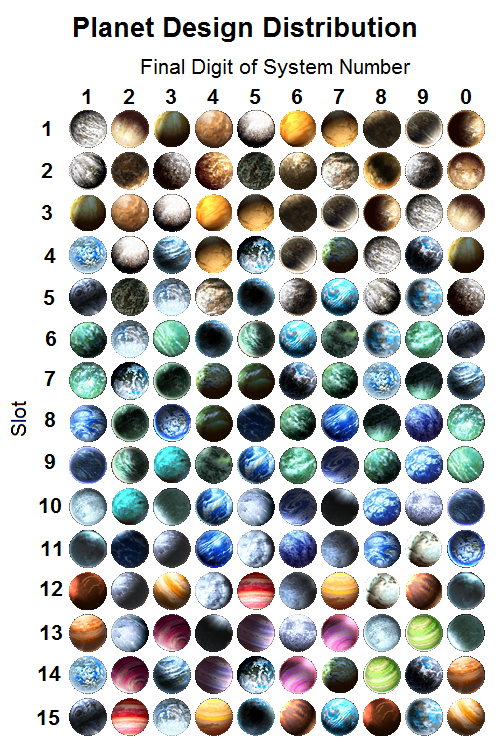
Expected image for new planets
You can use the following chart to determine the expected image a planet will receive if a certain position is colonized.
See also
Notes
- Version 7.5.0 Rebalance of Classes Release notes
- Version 7.4.0-pl2 Release Notes
- Planet sizes and temperatures sourced from the colonization details published for the original game
- Players of the discoverer class also get an additional 10% bonus on planet size (and therefore a 21% increase on number of fields), above the numbers listed. Players in a Researcher alliance will receive an additional 5% bonus on planet size.
Size is also affected by the universe settings. Most universes include a bonus number of fields, such as 30, which are added to each planet, after class bonuses are applied.
5. The temperature of a planet in Kessaril is given as a range where the maximum temperature is 40°C higher than the lowest temperature, for example 30-70°C. These numbers represent the minimum, average, and maximum of the upper end of this range.
6. Deuterium production is determined by the planets temperature. Since position 15 has by far the coldest planets, it produces by a significant margin the most deuterium.
|